|
Hits:31 , posted at 2026/11/25 14:40
CSBio
(Shanghai) is the exclusive distributor of Peptide Institute in China. For purchase inquiries, please contact CSBio (Shanghai).
Supersulfides are an emerging class
of molecules attracting increasing attention in life science research. Here, we
introduce Glutathione Trisulfide (GSSSG) and NAC polysulfides, which are highly
useful for analyzing sulfur metabolism pathways and investigating antioxidant
and anti-inflammatory activities.
The Research Potential of Supersulfides
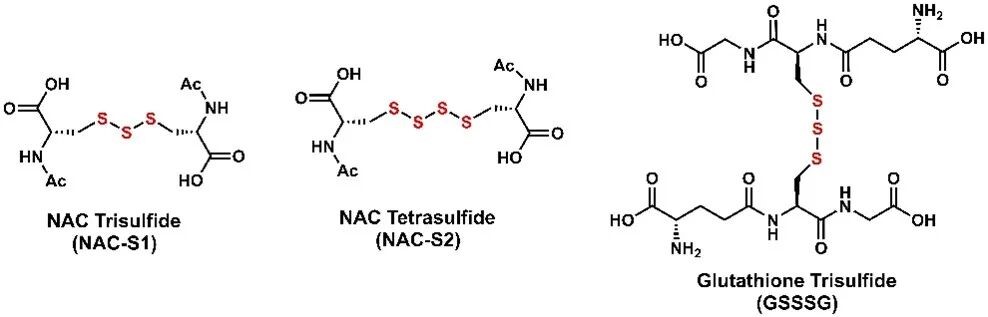
Understanding oxidative stress, inflammation, and signal transduction pathways is a central challenge in life science research. Supersulfides have recently attracted significant attention in this field.Recent studies have demonstrated that these molecules exhibit significantly stronger antioxidant and anti-inflammatory activities than conventional sulfur-containing compounds, making them powerful research tools that greatly expand experimental possibilities.We provide the following polysulfide derivatives related to supersulfides as research reagents:
NAC Trisulfide (NAC-S1)
NAC Tetrasulfide (NAC-S2)
Glutathione Trisulfide
(GSSSG)
What Are Supersulfides?
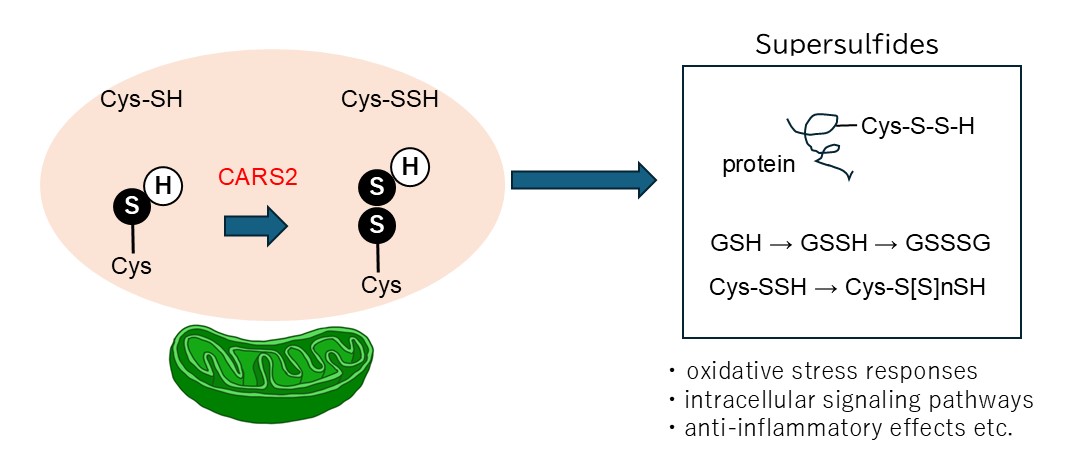
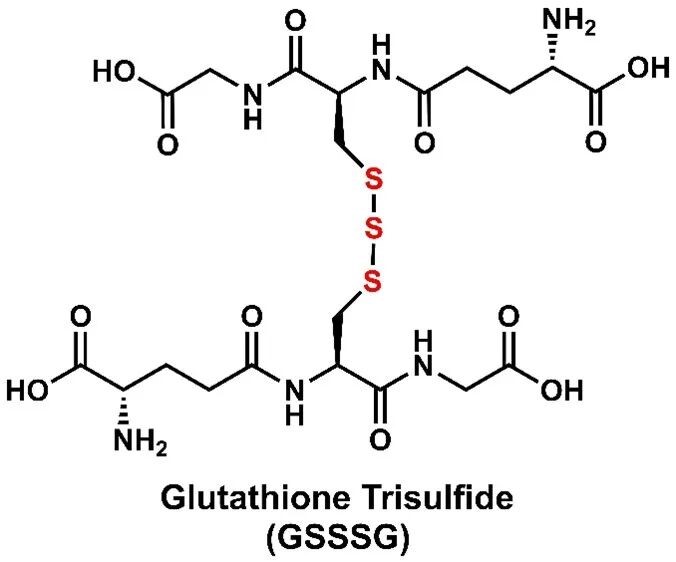
Supersulfides are molecules containing polysulfide chains formed by sulfur catenation, allowing for diverse reactivity. In biological systems, sulfur atoms are added to the thiol groups of cysteine and glutathione (GSH), forming hydropolysulfides such as CysSSH and GSSH [RS(S)nH], as well as polysulfides such as GSSSG [RS(S)nSR].Numerous important findings on supersulfides have been reported by the research group of Professor Takaaki Akaike at Tohoku University. His group demonstrated that supersulfides are not mere metabolic byproducts but are actively synthesized by CARS2 (cysteinyl-tRNA synthetase), and that they play essential roles in antioxidant defense and signal transduction1,2).These studies indicate that supersulfides are key regulators of oxidative stress, inflammation, and cellular signaling. Their roles are expected to contribute to the elucidation of biological phenomena, disease mechanisms, and the development of novel therapeutic strategies.
Physiological Roles of Supersulfides
Supersulfides are extremely reactive and exert diverse physiological functions depending on their reaction partners.Potent antioxidant and anti-inflammatory activitiesThey efficiently react with reactive oxygen species (ROS), free radicals, peroxides, and metal ions, thereby exhibiting strong antioxidant and anti-inflammatory effects3,4).Regulation of signal transductionSupersulfides react with electrophiles such as 8-nitro-cGMP to reduce their reactivity, and also persulfidates protein cysteine residues, thereby contributing to the regulation of redox signaling, transcription, and metabolism1,7).
Chemical Properties of Supersulfides
Under physiological conditions, supersulfides undergo repeated hydrolysis and reactions with nucleophiles and electrophiles, dynamically altering the number of sulfur atoms and generating a wide variety of molecular species8).Dual nucleophilic and electrophilic reactivityHydropolysulfides [RS(S)nH] normally behave as electrophiles; however, in the deprotonated persulfide anion state (RSS⁻), they function as nucleophiles. This dual reactivity enables reactions with a wide range of chemical species.High reactivity at physiological pHCatenation alters the electronic environment and lowers the pKa compared with the corresponding thiols. For example, while GSH has a pKa of approximately 8.9, GSSH has a significantly lower pKa of approximately 6.99). Consequently, GSSH exists as a nucleophilic persulfide anion even under physiological pH, exhibiting high reactivity10).Dynamic sulfur transfer reactionsPolysulfides [RS(S)nSR] exhibit polarized sulfur–sulfur bonds and are in hydrolytic equilibrium with water under physiological conditions. Through reactions with nucleophiles and electrophiles, sulfur atoms increase or decrease in number while undergoing transfer, rearrangement, elongation, and degradation, resulting in a cascade of supersulfide species.
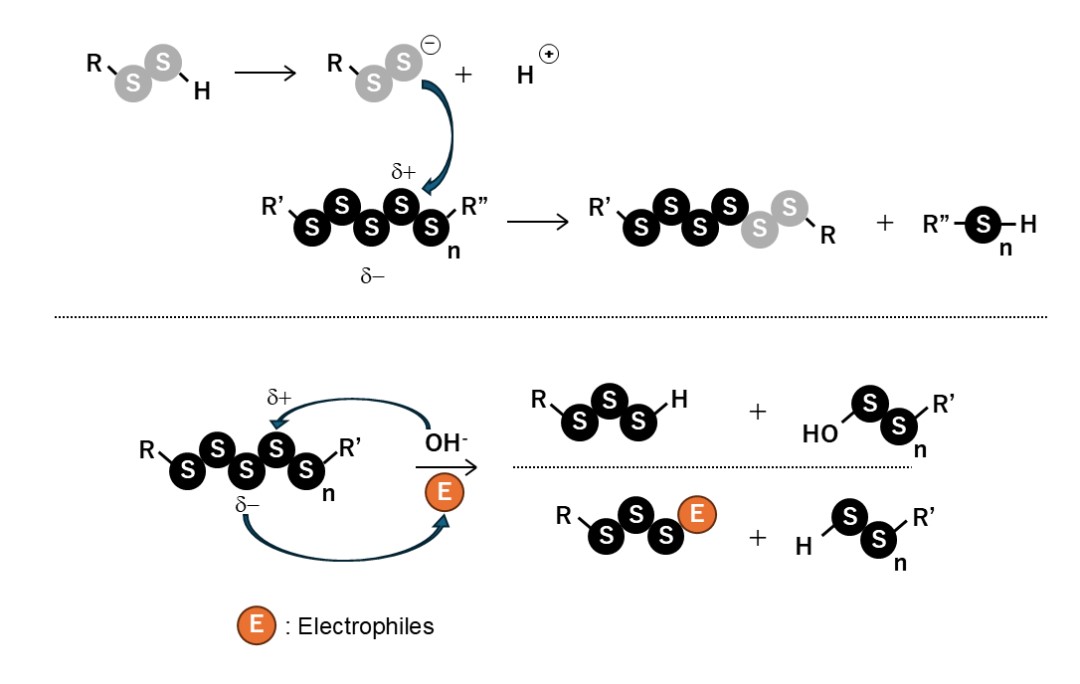
Fig. Chemical properties of supersulfidesHydropolysulfides [RS(S)nH] exist in equilibrium between the protonated RSSH and persulfide anion RSS⁻ forms. Because GSSH has a pKa of approximately 6.9, it exists as a highly nucleophilic persulfide anion under physiological conditions. Polysulfides [RS(S)nSR] readily react with nucleophiles (including persulfides and water) and electrophiles due to charge polarization. As a result, supersulfides undergo chain reactions to generate diverse molecular species.
Featured Research Reagents
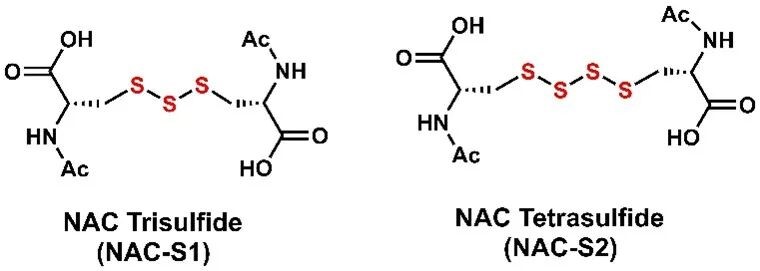
NAC Trisulfide (NAC-S1) / NAC Tetrasulfide (NAC-S2)
NAC Tetrasulfide (NAC-S2) efficiently generate intracellular supersulfides (e.g.,
GSSH, GSSSH) via reaction with endogenous GSH.11).
Enhanced Potency (NAC-S2) NAC-S2 exhibits stronger antioxidant activity and
polysulfide donor capacity compared to NAC-S1.
Applications Analysis of sulfur metabolic networks, endogenous
supersulfides, and signal transduction pathways12,13,14).
GSSSG(Glutathione Trisulfide)
Endogenous Polysulfide Donor A naturally occurring, GSH-derived polysulfide that exerts
antioxidant and anti-inflammatory effects in cells and tissues1).
High Solubility &
Stability Highly water-soluble
(contains TFA counterion) and verified stable as a powder at −20 °C.
Applications Ideal for evaluating antioxidant and anti-inflammatory
efficacy in various disease models15,16,17).
|
Code
|
Product
Name
|
Quant
|
|
3432-v
|
Glutathione Trisulfide
|
5 mg
|
|
3433-v
|
NAC Trisulfide
|
5 mg
|
|
3439
|
NAC Tetrasulfide
|
5 mg
|
CSBio (Shanghai) is the exclusive distributor of Peptide
Institute in China. For purchase inquiries, please contact CSBio (Shanghai).
The Future/Impact of Supersulfide Research
Supersulfides have become an increasingly important topic in life science research. Their high reactivity, dynamic chemical behavior, and diverse physiological functions are expected to greatly contribute to the elucidation of biological phenomena and disease mechanisms.The research reagents introduced here are powerful tools for efficiently analyzing the biological actions of supersulfides. We encourage their use in studies of oxidative stress, inflammation, and signal transduction.
1. T. Ida et al., Proc. Natl. Acad. Sci. U.S.A., 111, 7606-7611 (2014).
2. T. Akaike et al., Nat. Commun., 8, 1177 (2017).
3. U. Barayeu et al., Br J Pharmacol., 183, 115-130 (2023).
4. T. Zhang et al., Front.Immunol., 16, 581385 (2025).
5. Y. Yamada et al., J. Biol. Chem. 298, 104710 (2023).
6. M. R. Filipović et al., Chem. Rev., 118, 1253–1337 (2018).
7. T. Akaike et al., Free Radic.Biol.Med., 222, 539-551 (2024).
8. Seikagaku, 93, 708-716 (2021).
9. H. Li et al., Redox Biol., 24, 101179 (2019).
10. Seikagaku, 93, 613-620 (2021).
11. T. Zhang et al., Cell Chem. Biol., 26, 686 (2019).
12. H. Takeda et al., Redox Biology, 65, 102834 (2023).
13. X. Sun et al., Immun Inflamm Dis., 11, e959 (2023).
14. X. Li et al., Int. Immunol. 36, 641–652 (2024).
15. H. Kunikata et al., Sci. Rep., 7, 41984 (2017).
16. H. Tawarayama et al., Ocul. Immunol. Inflamm., 30, 789–800
(2020).
17. H. Tawarayama et al., Sci. Rep., 13, 11513 (2023).
希施简介/CSBio Introduction
30多年来,CSBio致力为客户提供全方位多肽核酸解决方案。可提供8大类产品:
1)多肽CRDMO服务-GMP和研发多肽生产,有USFDA认证API多肽生产资质
2)多肽研发和生产设备-从研发到生产型合成仪,裂解仪,纯化制备,装柱机,冻干机,其他制药设备以及多肽实验室和生产车间技术支持
3)多肽关键原料- 保护标准和高质量氨基酸和多肽试剂,有相关验证数据,稳定性数据和DMF技术文件支持
4)DNA/RNA寡核苷酸合成仪-可用于研发、工艺开发和生产
5)DNA/RNA合成单体和配套试剂-以高性价比的产品为客户提供整体解决方案
6)美容产品原料——安全化、科学化、高功效美容产品研发与生产
7)GLP-1多肽及相关中间体
8)Peptide Institute中国唯一代理
CSBio has brought together more than 30 years’ experience serving the life science community, the only professional company who has Total Peptide oligo Solution for every peptide users which cover eight main categories of products and services:
1)Peptide CRDMO service -GMP and R&D peptide production, with API peptide production approved by USFDA
2)Peptide Instrumentation - from R&D up to Large Scale Manufacturing-type synthesizer,Cleavage systems,PreHPLC system,Freeze-Drying Machine,Other pharmaceutical equipment,Column packing equipment and peptide production technical support
3)Peptide key raw material - High Quality Standard Grade and High Grade Fmoc-protected Amino Acid, peptide reagents, coupling reagents, resins and special reagents, supported by relevant validated QC data, stability data and DMF technical documents.
4)DNA/RNA oligonucleotide synthesizers that can be used from research、process development and production
5)Reagent for DNA/RNA Synthesizer-To provide cost-effective products to provide customers with the overall solution
6)Raw materials for cosmetic products - R&D and production of safe, scientific and high-efficacy cosmetic products
7)GLP-1 peptide and its related intermediates
8)CSBio is the sole agent of Peptide Institute in China
CSBio (Shanghai) Ltd 希施生物科技(上海)有限公司
China (Shanghai) Pilot Free Trade Zone, 85 Faladi Road, Building 2, Room
502 ,Shanghai 201210, China
中国(上海)自由贸易试验区法拉第路85号,2幢502室
邮编:201210
Email/邮箱:info@csbiochina.com
Tel/电话:+8621-50781653/50781655
Fax/传真:+8621-50781652/021-50781656
Website/网站:www.csbiochina.com
www.csbio.com
|
 沪公网安备 31011502005552号
沪ICP备13005633号-1
 Technical information